

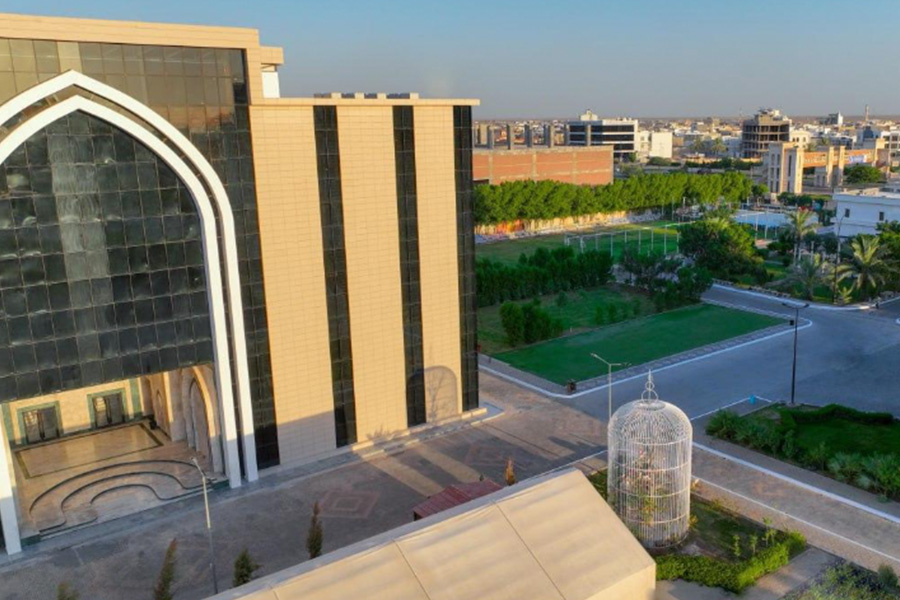
In the city of Ramadi, in Iraq’s Al-Anbar province, sits an institution that quietly changed the shape of private higher education in the country. The University of AlMaarif was established in 1993, making it the first private college in Al-Anbar province and only the sixth private college founded anywhere in Iraq. More than three decades later, it remains one of the region’s most recognisable names in higher education, having graduated more than twenty thousand students who now work across Iraq and beyond, with a number going on to complete master’s and doctoral degrees both inside and outside the country.
What makes this history worth telling isn’t simply longevity. Private higher education in Iraq has never been an easy sector to build, let alone sustain across decades marked by conflict, economic disruption, and shifting government policy. A college that opened its doors in 1993 and is still operating today, still expanding its academic offerings, and still attracting new students from across the country, has clearly done something right in how it has adapted.
A Foundation Built on Recognition, Not Just Ambition
The college’s legal standing matters as much as its age. It was formally recognised under Iraq’s private universities and colleges law, law number 13 of 1996, with its accreditation documented in official records shortly afterward. That recognition placed the institution under the direct scientific supervision of the Ministry of Higher Education and Scientific Research, meaning its curricula are built to align with the standards applied across Iraq’s public university system rather than operating as a separate, lower-tier track. It has also secured accreditation recognised by international universities, which matters considerably for graduates who want their degrees to carry weight beyond Iraq’s borders.
This is not a minor technicality. Across much of the developing world, private higher education has sometimes struggled with a credibility gap, seen as a faster or easier alternative to public universities rather than an equally rigorous one. Al-Anbar’s oldest private college has spent over thirty years working against that assumption, embedding itself in the same regulatory and academic framework that governs the country’s public institutions while still offering the flexibility, class sizes, and administrative responsiveness that a private college makes possible.
A Campus Built Around Access as Much as Academics
Today the university serves a medium-sized student body, generally cited in the range of six to seven thousand students, drawn from across Iraq’s provinces rather than exclusively from Al-Anbar itself. It operates as a coeducational institution and has built out a set of supporting facilities that go beyond the classroom: a library, student housing, sports facilities, and financial aid and scholarship programmes designed to widen access rather than restrict it to students who can pay full tuition upfront.
That last point deserves particular attention. In a gesture aimed at attracting both Arab and international students, the university has offered a set of fully funded scholarships covering tuition fees alongside a monthly living allowance, spread across all of its academic departments. For a private institution in a province that has faced real economic pressure over the past two decades, committing resources to fully funded scholarships is a meaningful signal about institutional priorities. It suggests a college more interested in building a diverse, well-supported student body than simply maximising enrolment revenue.
Fourteen Departments, One Consistent Standard
The university now spans fourteen academic departments, a number that has grown steadily rather than all at once, with new departments launched as the province’s economic and professional needs have shifted. Departments have been added in direct response to identified gaps in Al-Anbar’s workforce rather than as a matter of institutional prestige. A Pharmacy department, for instance, was launched in the 2021 to 2022 academic year after officials identified an urgent regional need for trained pharmacists, while a Physical Education and Sports Science department dates back to the 2017 to 2018 academic year. More recently, a Business Administration department was established for the 2023 to 2024 academic year to meet growing demand for management and administrative training in the province.
Each new department has followed a similar process: an identified need in Al-Anbar, a formal study into the resources and staffing required, and a submission to the Ministry of Higher Education for approval before teaching begins. That process, repeated across more than a decade of expansion, points to an institution that treats its academic offerings as something to be built deliberately rather than added opportunistically.
The College of Engineering Technology
Among the university’s academic divisions, the College of Engineering Technology has become one of its more distinctive offerings, and it’s here that students looking to Study Science and Technology tend to find the clearest path. The college brings together several specialised engineering departments under one roof, each built to produce graduates with hands-on technical skill rather than purely theoretical training.
The Computer Engineering Techniques department is one of the college’s longest-running and most established programmes, having been founded in the 2008 to 2009 academic year. It has since become recognised as one of the university’s stronger departments, with a teaching staff selected specifically for their competence in engineering practice. Graduates leave equipped to design electronic circuits, work directly with computer hardware components, and handle both networking and programming responsibilities, skills that translate directly into the kind of technical roles the wider region has needed as its economy has modernised. The department runs on a semester system and offers both morning and evening study tracks, a detail that matters considerably for students who are balancing coursework with work or family responsibilities.
A newer addition to the same college is the Medical Instruments Engineering Techniques department, established in the 2022 to 2023 academic year in direct response to Al-Anbar’s need for specialists capable of maintaining and operating medical equipment. The department accepts graduates of scientific, biological, applied, and industrial preparatory studies, and its staff were selected specifically for their expertise in electronic engineering, control systems, and communications. Students graduate after four years with a bachelor’s degree in Medical Instruments Engineering Techniques, trained to work with the kind of specialised hospital and clinical equipment that the province’s healthcare system depends on. The department’s stated aim is to become an accredited educational unit that contributes meaningfully to community development, a goal that reflects the wider institutional pattern of building academic programmes around genuine regional need rather than following trends set elsewhere.
What ties these engineering technology departments together is a shared emphasis on applied, technical competence over purely academic theory. Students are trained to walk directly into technical roles: maintaining equipment, designing systems, and solving practical engineering problems that Al-Anbar’s hospitals, businesses, and infrastructure projects actually need solved. That focus on applied skill has become something of a hallmark for the college more broadly, distinguishing its graduates in a regional job market where practical, immediately useful technical training carries real value.
A Regional Institution With a Wider Reach
It would be easy to think of a college in Ramadi as a purely local institution, relevant only to Al-Anbar province. The numbers tell a different story. Graduates have gone on to further study both inside and outside Iraq, and the university’s scholarship programme has been explicitly designed to attract students from across the Arab world and beyond, not just from the immediate region. For a college founded in the aftermath of a difficult decade for Iraqi higher education, and one that has since operated through further periods of conflict and instability, that kind of sustained outward reach is a meaningful achievement in its own right.
Admissions policy has also been shaped with access in mind rather than exclusivity for its own sake. Acceptance is based on students’ prior academic records rather than a narrow standardised entrance exam, and the institution has generally maintained a relatively open admissions rate compared with many of Iraq’s more selective public universities. That approach reflects a broader philosophy that has run through the college’s history: that private higher education should widen the pool of students who can access a quality technical or professional education, rather than functioning as a smaller, more expensive replica of the public system reserved for those who can afford it without support.
The physical growth of the campus has tracked the growth in departments and enrolment. What began as a single private college with a narrow initial set of programmes has, over three decades, added dedicated facilities for its expanding technical departments, additional laboratory space for programmes like Medical Instruments Engineering Techniques, and the administrative infrastructure needed to support a student body of several thousand. None of that growth happened automatically. Each expansion required ministry approval, funding, and staffing, and the fact that the institution has managed to secure all three repeatedly over three decades says as much about its administrative stability as its academic ambitions.
More than three decades after opening its doors as Al-Anbar’s first private college, the institution continues to add departments, expand its scholarship offerings, and build out academic programmes tied directly to the province’s evolving needs. For prospective students weighing where to study engineering, medical technology, or a growing list of other applied disciplines in Iraq, it remains one of the country’s more established and consistently regulated private options, a track record built one department, one graduating class, and one regional need at a time.