

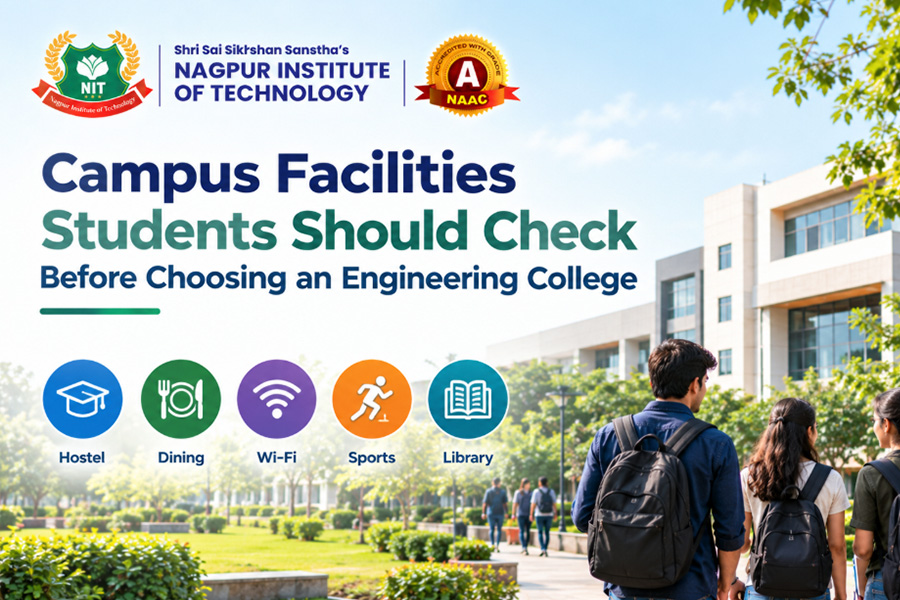
Campus facilities affect engineering education when they change what a student can actually do. A large building, landscaped entrance or air-conditioned admission office tells very little about the quality of learning. Students should spend their visit checking the spaces they will use every week: laboratories, classrooms, library, computing access, study areas, transport points, washrooms, drinking water and student-support facilities.
The right way to inspect engineering college facilities in Nagpur is to connect each facility with a student task. Ask, “What will I use this for, how often, and can students access it when they need it?”
Laboratories: look for use, not display
Engineering laboratories should match the curriculum. A Civil student needs practical exposure to surveying, materials, geotechnical or environmental work. Mechanical students may need workshops, thermal and manufacturing-related facilities. Electrical students need access to machines, circuits, measurements and power or control experiments. Computing students need dependable systems, software access and networked learning environments.
Do not stop at the doorway. Ask whether all equipment is working, how many students share a batch, whether every student performs the experiment, and how practical work is assessed. Check whether project teams can use laboratories outside the scheduled practical hour.
A lab with ten pieces of equipment can be more useful than a room with fifty items that students rarely touch.
The library should solve real study problems
An engineering college library in Nagpur is valuable when it supports the subjects students are actually studying. Check the availability of current textbooks, reference books, journals, e-resources and previous university papers where permitted. Look at seating capacity and opening hours. A library that closes before students can use it after class may have limited value for commuters.
Digital access matters too. Ask whether students can use subscribed databases or e-books from campus systems, how they receive login access and whether library staff help them find technical material.
The simplest test is observation. Are students reading, working on assignments or using digital resources, or is the space mostly empty during an academic day?
Computing access matters in every branch
Even core engineering now depends on software. Civil students may use CAD, structural analysis, GIS or project-planning tools. Mechanical students can work with design and simulation software. Electrical students may use circuit and power-system tools. All students need access to online learning, documentation, coding or data analysis at some stage.
Ask what software is legally available, whether students can use it for projects, and whether laboratories remain accessible beyond scheduled classes. Also ask whether campus internet is reliable in academic areas. A high advertised bandwidth is less useful than stable access where students study.
Classrooms affect attention more than students expect
Check ventilation, lighting, seating, visibility and basic audio-visual support. More technology does not automatically mean better teaching. A projector is useful only when faculty members use it well. Blackboard or whiteboard visibility still matters for equations and problem solving.
Look at batch size. Can students hear questions from the back? Is there space for interaction? Engineering involves long hours on campus, so basic comfort affects concentration.
Transport and accommodation are academic issues too
A two-hour journey each way can reduce the time available for assignments, practical work and sleep. Students from outside the city should calculate the complete daily route before admission. Test it during college hours if possible.
If hostel or nearby accommodation is needed, inspect safety, water, food, internet, study space, distance and total cost. Do not choose a room only on rent. An inexpensive place that makes attendance difficult can become costly in other ways.
Parents should also ask whom students contact during a medical problem, how emergency support works, and whether campus security arrangements are explained clearly.
Accessibility and basic services should not be treated as extras
NIRF includes outreach and inclusivity among its broad quality parameters. Students with mobility, health or other accessibility needs should check ramps, lifts where required, accessible washrooms, pathways and classroom access directly rather than assuming they are available.
Every student should inspect drinking water, washrooms, cleanliness, common areas and canteen or meal options. These may sound minor during admission week. After 180 working days, they are part of daily college life.
Student spaces reveal whether learning continues after class
Technical clubs, project rooms, seminar spaces, sports facilities and activity areas can help students build teamwork and communication. The key is participation. Ask what events took place in the previous semester and how students join them.
A well-used modest space is more valuable than an impressive facility that is mostly locked.
Use one final campus test
Before leaving, imagine an ordinary day from arrival to departure. Where will you attend lectures? Where will you complete practical work? Where can you study between classes? Can you find a book, charge a laptop, eat, get drinking water, ask a faculty member a question and travel home safely?
Take notes after the visit. Record travel time, laboratory observations, library access, hostel or transport details and answers that need verification. Written notes preserve differences that are easy to forget after several campus visits.
Facilities should make those tasks easier. Judge the campus by that standard, and the decision becomes much clearer than comparing photographs.